

“When cars no longer have a steering wheel, premium mobility can be newly defined. In future, people traveling from A to B will be able to surf the Internet at leisure, play with their children – or do concentrated work,” says Melanie Goldmann, head of Culture and Trends Communication at Audi. “Together with the experts from the Fraunhofer Institute, we want to find out what is important for making optimal use of time in a self-driving car.”
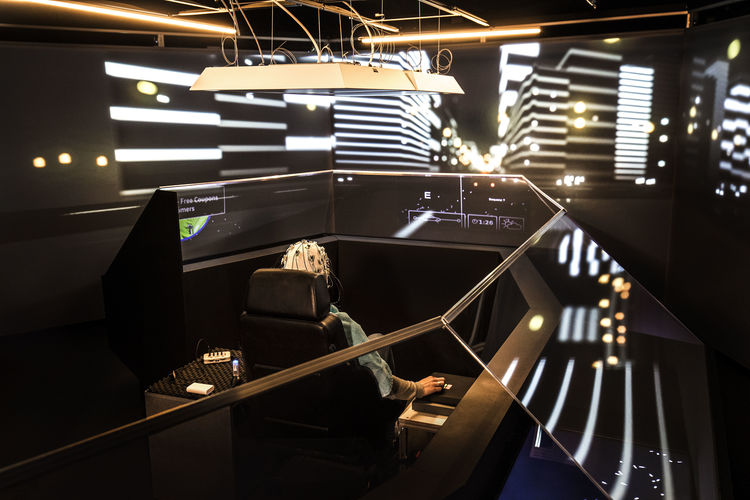
For the laboratory experiment at the Fraunhofer Institute in Stuttgart, Audi has specially built a driving simulator that reproduces the situation of automated driving: with a variable interior and without a steering wheel. Large-scale projections convey the impression of a city drive by night. Via displays, the researchers can introduce digital distractions, the windows can be dimmed, and the color of the lighting and noise background change.
The focus was on young test persons, so-called millennials, who were born after 1980 and are regarded as receptive to self-driving cars. In the experiment, the 30 test persons carried out various tasks requiring concentration – comparable with a work situation in a self-driving car.
As they did this, their brain activity was measured (EEG), as well as reaction times and error quotas, and subjective impressions were noted. The results of the EEG were unambiguous: in an environment without disturbances, the human brain is more relaxed. The windows were dimmed, the light settings optimized, and digital messages were suppressed. Tasks were then solved better and more quickly. The test persons also stated that they were less distracted.
By contrast, a driving situation that was “close to reality” in the robot car made greater demands on the brain: in this case, the participants saw some advertising, received information from social networks, and did not benefit from pleasant lighting settings or dimmed windows.
“The results show that the task is to find the right balance. In a digital future, there are no limits to what can be imagined. We could offer everything in the car – really overwhelm the user with information,” says Goldmann. “But we want to put people at the center of attention. The car should become a smart membrane. The right information should reach the user at the right time.”
The “25th Hour” project
Today drivers spend an average of about 50 minutes per day at the wheel. In the 25th Hour project, Audi is investigating how this time could be used better in a self-driving automobile. The project is based on the assumption that an intelligent human-machine interface will learn the user’s individual preferences and adapt flexibly. In this way, Audi customers will gain full control of their time – they will be masterful time managers.
In a first step, the project team looked at people in Hamburg, San Francisco, and Tokyo, focusing on two aspects. How is infotainment used in the car today? And what would people like to do with their free time in the car of the future? The results were then discussed with a variety of experts, including psychologists, anthropologists, and urban and mobility planners.
In a second step, the Audi team defined three time modes that are conceivable in a self-driving car: quality time, productive time, and time for regeneration. In so-called quality time, people spend their time, for example, in activities with their children or telephoning family and friends. In productive time, they usually work. In down time they relax by reading, surfing the Internet, or watching a film.
To research these time modes further, Audi recruited the help of scientists from the Fraunhofer Institute. In the current research series, the team is principally concentrating on productive time.