


Ziehl-Abegg is already at more than 70 percent peak efficiency with its centrifugal fans, so every opportunity for the optimisation of performance must be utilised. The new centrifugal impeller possesses features of three completely different approaches to Biomimicry: from both aerodynamics (ornithology) and hydrodynamics (marine biology) and biomechanics (trees). Savings in material content and improved aerodynamics halve CO2 emissions associated with manufacturing, whilst maintaining the same ventilation performance. Modern injection moulding tools, each costing more than half a million euros, enable the company to implement the geometries which have been optimised through the application of Biomimicry.
The trailing edges of the fan blades are modeled on the owl wing. “As the quietest bird of prey, the owl has already been used as a role model for several designs,” says CEO Peter Fenkl. Serrated trailing edges of fans are now seen as a trademark of Ziehl-Abegg. In the new fan however, the design of the serrations was a little smoother.
Evolution has optimised the flow efficiency of the humpback whale overall in such a way that, despite its body size, it is considered a very good and agile swimmer. If this had not been the case, it would also have been unable to make its long journeys through the world’s oceans without having to feed. The latest generation of centrifugal fans at Ziehl-Abegg is now benefitting from this knowledge of Biomimicry.
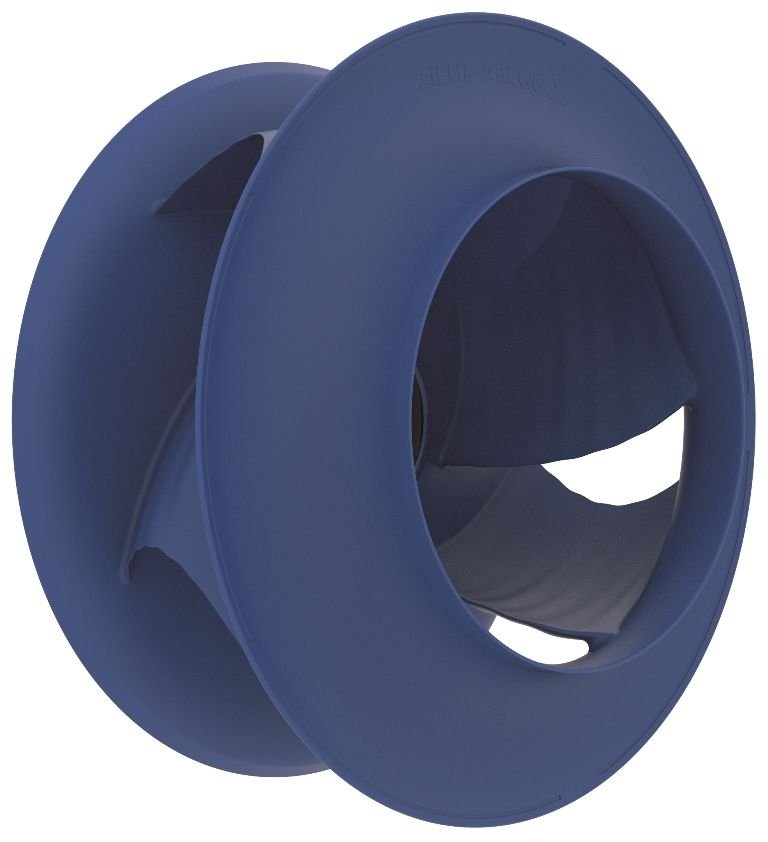 The developers at Ziehl-Abegg also drew inspiration from Professor Claus Mattheck. The “tree whisperer” or “tree pope, “as the media call him, creates a bridge between nature and technology: the professor is, after all, a pioneer of the science of biomechanics. Trees are a prime example of optimum strength with minimum use of materials.
How has this been achieved with the ZAbluefin fan? The five blades of the centrifugal fan merge into both the cover and back plate in exactly the same way as trees grow upwards: at a slight radius to the ground. This is scarcely visible with the naked eye, because the curves which mimic a tree are minimal. Nevertheless, these bionic approaches in the blade transition provide the same strength as heavy wings – enabling the use of materials to be significantly reduced. Less material consumption in production also means a lower carbon footprint.
The air flow in centrifugal fans hits the fan blades at different angles, depending on the volume flow. The whale has to overcome similar challenges when swimming in the sea: the movement of the fins causes their angular position to constantly change. If its pectoral fins were to be positioned at too steep an angle to the opposing current, strong turbulence would result in the water separating from the fins. “High flow losses and noise are characteristic features of strong turbulence” says Dr. Walter Angelis, Technical Director at Ziehl-Abegg. The design of the fins on a humpback whale has been optimised over millions of years. That’s why the leading edges of the whale fins contain golf ball-sized nodules (technical term: tubercle). This allows an animal weighing 25 to 30 tons to swim very quickly and nimbly using its long pectoral fins. “We recreated this aspect at the leading edge of the fan blades and implemented it in the form of a rippled surface,” explains Angelis.
The flow engineers also took a closer look at the whale’s tail fin, the “fluke.” The V-shaped contour of the tail fin section delays any potential flow separation – which enables the fan to be used for numerous pressure ranges. The latest generation of centrifugal fans at Ziehl-Abegg is now benefitting from this knowledge of Biomimicry. The product name ZAbluefin is based on the English word “fin”.